Thursday, May 19, 2011

Metacognition: Jane Eyre Mashup

      A mashup is defined as a "creative combination or mixing of content from different sources," and though I wasn't before aware, is reflected in several types of art. I'd figured it to be a free art form collecting popularity but not yet clearly defined or momentous--but mistaken, I found five-month old "United States of Pop 2009 (Blame it on the Pop)" by DJ Earworm--a popular song that has secured 36.4 million views on YouTube in its short life--terms itself a mashup. It features one to two line samples from the top 25 hits of 2009, and though seemingly different in key and time signature, the lyrics of the songs fit together under an umbrella theme--picking ourselves up after being metaphorically knocked down. Additionally, what sounds like the drum beat and guitar tab to the Black Eyed Peas' "I Gotta Feeling" unremittingly plays in the background, adding to the illusion of a "single consciousness." DJ Earworm, who also produces mashups of individual artists' work, has said of his experiences with it, "It's great when I get to do a mashup for an artist, because it allows me to really dig deep into a single act and really see what makes them tick." Essentially, the artists' work creates or leads him to sculpt the themes for his songs, and when he looks at them with lenses to filter out anything that doesn't relate to the theme--he finds deeper implications about the theme itself. Though his songs are angled to draw popularity versus sparking the intellect, I found the fundamental steps of both of our processes were similar.

      While working on the mashup assigned in English with my partner Jordan, I arrived at a set of realizations relating to the media quoted in the mashup and its sources.  We began the mashup by inserting large blocks of text from printed and online sources that were broadly related to enlightenment. We imported paragraphs satiated with content of personal moments of enlightenment, dialogues in which characters analyzed their own epiphanies, and descriptive passages which commented on the nature of enlightenment. Then, it was important not to mechanically cut out pieces of text with specific names or places, as the later integration of those into the mashup would make it more unique and interesting. Though we found it important to be open-minded and ambitious while we quarried printed and online media for possible quotes, we ensured our sources met a certain standard; just as DJ Earworm hadn't scraped for theme-related sentences in psychology self-help forums, we were not to skulk about on Yahoo! Answers seeking personal enlightenment experiences.  In fact, I found that average experiences of people could be articulated through the layers of depth in the mashup, or simply through use of a more sophisticated piece of literature whose main character was slightly out of the ordinary but not unrelatable.

       However, this process led to the satiation of individual quotes with diverse ideas. To cut the quotes to the bone would have required more time and collaboration. Due to diametrically opposed schedules, Jordan and I could only meet to work together when the order of the mashup elements was being finalized and the site was being put up. Thus, the duties of the mashup creation process had been split between us, with me making sure I dug up enough quotes to exasperate as many aspects of enlightenment as possible, and with Jordan continuously interpreting added elements and ordering them, leading to depth. We each spent many hours on the Google Doc. adding or editing, but realistically with a two-dimensional virtual document and less than a week's worth of time (conflicting with a major holiday and athletic competitions), the closer, more collaborative and mutually beneficial work environment I envisioned had to be compromised in search of a more practical and efficient way to complete the project.

      If asked what I would improve upon regarding our group dynamic or collaboration, the pressing circumstances in mind, I would probably be more efficient and manage my time more effectively. Had I completed my quarry for quotes several days before, it would have allowed for mutually invested time in the trimming and organizing of the mashup elements. I was hesitant to pull the plug on my  constant import of quotes into the project because I feared there would not be enough concrete material to continue. But had I initiated a sort of preliminary organization process of the elements--even something as simple as categorizing--I could have familiarized myself with the material we had thus far, and gained a more refined image of what quotes we needed. Additionally, I could have been a direct participant in the trimming of sentences that didn't directly relate to enlightenment, thus tightening the focus of the mashup. After sampling Austin and Declan's completed mashup--each quote of which is a line, or at times two--I realized the power of conciseness in a project like this. Their mashup was not only elegant and flowed collectively, but was direct, structured, and wise.

It Matters: The Yin-Yang


       Toward the end of our reading of Jane Eyre, we briefly discussed  how the success of Jane's relationship with Rochester could be explained by the principles of the Yin-Yang. Jane emerged from her experiences at the Moor House more independent and self-actualized, whereas Mr. Rochester's blindness had forced him to retract his authoritarian air and accept dependence on another human being. Thus they became closer to equals, with neither yielding to or exercising mastery over the other; rather, they became a whole entity through embodying aspects of each other.

       The theory behind the Yin-Yang holds that each side of it holds a part of the opposite side because qualities constantly become each other in a cyclical process, partially comparable to Hegel's dialectics.  No quality ever exists in its absolute state, but may achieve temporary dominance.  However, when a large imbalance occurs between elements, Chinese traditional medicine cites this the cause of illness. The Yellow Emperor of the Han dynasty argued that if the Yang, or male force, was excessive and strong, one would face repeated exposure to heat, which would damage the spirit and lead to severe pain. If the female force, or Yin, was too strong, one would become excessively cold, which would cause the body to swell and eventually injure the spirit. Either infirmity would lead to death if left untreated.

      In our modern era, the Yin-Yang is more commonly applied to the political or social aspects of our society, but still relates to modern medicine. In one sense, the "mental health" category of medicine can offer effective therapy to those who are depressed or only channel negative energy. Along with the principles of the Yin-Yang, such people sometimes undergo trauma or pass through difficult times that escalate their negative emotions, and opt for help when at the peak of discontent, so health issues don't emerge or they don't take their own lives.  Hopefully this help facilitates their fundamentally feeling the "opposite" of before, while still recognizing their negative emotions as a part of them. However, on the flip side, modern medicine also enables psychiatrists to prescribe medication to people suffering from grave mental disorders and further delay constructive methods of psychological treatment in favor of temporary alleviation of symptoms. 

      In the political field, diversity between opposing agendas and moral standards has been said to have positively impacted our society. Psychologist Jonathan Haidt argues that through embodying ideas that fundamentally deviate from our own, such as with party doctrines, we can "cultivate moral humility." This is important because it is crucial to interpersonal understanding and cooperation. In his New York Times Op-Ed article, David Brooks describes that "For decades, people tried to devise a rigorous “scientific” system to analyze behavior that would be divorced from morality. But if cooperation permeates our nature, then so does morality, and there is no escaping ethics, emotion and religion in our quest to understand who we are and how we got this way." Hence, it becomes clear that the process by which our behavior has been analyzed can be characterized by the Yin-Yang; it has shifted from traditional thought, to scientific, systematic evaluation, and now to a system where science is predominant but more conscious of humanitarian aspects of our development. In totality, however, the fact that psychologists and behavior analysts are embracing the principles of the Yin-Yang, consciously or not, and its presence in Jane Eyre and even relationships today, shows that its teachings are still universal and pertinent, though the traditional internal and medical applications of the Yin-Yang did not heavily spread to the Western world.

Tuesday, May 17, 2011

360 Degrees: Life Simulation Games

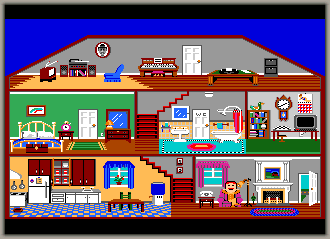
    In 1985, Activision released Little Computer People, a life simulation game created by David Crane for C64 computer systems. The game involved observing and interacting with a "little computer person," or LCP, who resided in what is essentially a two-dimensional doll house. Rather than controlling your LCP, you would interact with him through typing out suggestions for his activities (depending on his momentary needs), rewarding him with gifts with which he could spend his time, or inviting him to play parlor games. Each LCP had his own personality specifications and randomly chosen name, and for many this personified their LCPs, allowing families and friends to bond over what their respective LCPs had done the night before. Little Computer People has functioned as a blueprint for later life simulation games, notably the Sims.

     Between the release of LCP and The Sims came SimCity, a "system simulation" game released in 1989. In this game, you are able to create cities populated by "simulated citizens," and have full control and authority over the city's development. SimCity has no final objective or goal planted in it, but the appealing challenge is to build a city, perhaps your ideal city, that is able to sustain itself through the simulation. You want successful industries, an attractive lifestyle, happy people, and tax revenue so you can further develop the city.

     Then after, came "The Sims", "The Sims 2", and more recently, "The Sims 3." These are life simulation games in which you create simulated people, or Sims, move them into a house or build one yourself, and then control their actions throughout the stages of their lives. In the most recent installment, The Sims 3, there is no concrete objective other than optional fulfillment of the “Lifetime Wish” you select in “Create a Sim” mode. It is beneficial, however, for your Sim to develop skills associated with that wish, or undertake a job that relates to it, because you will gather more lifetime happiness points and be able to purchase special abilities for them. There is a separate currency, called “Simoleans” that the Sims make from work and that you use to purchase basic commodities and furniture, and build houses.

     You can choose to create your Sims or use a set of pre-made families. The “Create a Sim” function, however, is so comprehensive and multifaceted that it enables one to almost accurately represent a person from real life, both physically and mentally. Physical traits can be customized from weight to the color of hair roots and tips, and mental aspects, from favorite food to a set of five different personality traits, which could include “hot headed” or “charismatic.” This wide range of customization options is one of the appealing aspects of the Sims series, and is also reflected in the amount of options and flexibility you have in designing their homes.

     Another aspect of the Sims 3 that one might find attractive is the fictional narrative behind your characters; though it is simulated, the story can be engaging and yet realistic and relatable to some degree. Players see it as a more interactive, entertaining, and definitely engaging activity than perhaps writing a story or reading a comic. This can greatly fuel "escapism", a large attraction for any life simulation game, defined as a "habitual diversion of the mind to purely imaginative activity or entertainment as an escape from reality or routine."  Other players may also seek to project people and situations from their own life into the Sims in an idealistic but nonexistent way.  Because the game is so absorbing, it is important to raise the question of whether living in an idealistic world improves or worsens actual life. From reading posts on the Sims 3 community site, it seems that routine escapism, possibly to a virtual world they find favorable to their actual reality, can prevent people from taking steps to solve issues present within their lives. In addition, many people use cheat codes to rack up millions of Simoleans in the game, which can support the highest standards of luxury, and is unrealistic. However, it’s also important to question whether absorption in a life-simulation game can have positive effects. In the Sims 3, for example, improving in skills associated with a Sim’s academics or job will greatly boost their confidence about work, happiness level, and actual improvement within that field. This purely logical nature of the game may motivate some people to take constructive action to improve their lives, or reconsider their priorities.